For years, I built websites for businesses.
If you spent any time around WordPress during its rise, you probably remember the promise. A small business could buy a beautifully designed theme for less than dinner for two and suddenly have access to something that looked like it came from an expensive agency.
The demos were gorgeous: carefully selected photography, concise headlines, clean layouts, and features that appeared exactly where they belonged. It was easy to look at one and imagine your own company occupying that same polished space.
Then your company moved in.
The carefully curated photography gave way to whatever images were actually available. The six-word headline expanded because the business had considerably more to say. Search optimization required attention. Forms needed to connect somewhere. Plugins accumulated. One update affected another. Performance slowed. Someone fixed one problem and created a different one.
Eventually, another person arrived promising to rebuild the whole thing properly.
None of this meant WordPress had failed.
WordPress changed the web. It dramatically lowered the cost of creating and maintaining a professional website and gave millions of businesses capabilities that had previously been out of reach.
The promise was real. The mistake was assuming that because something had become easier to begin, it had become easy to do well.
I have been thinking about that a lot lately because we are doing it again, only this time the technology is capable of reaching much further into the way businesses actually operate.
The disappearing barrier
Artificial intelligence may have the simplest interface we have ever placed in front of such a powerful technology.
In many cases there is almost nothing to learn before beginning. You describe what you want and, within seconds, something appears that can be surprisingly close to what you had in mind.
A proposal takes shape. Research that once consumed an afternoon can be gathered and synthesized quickly. A presentation begins to assemble itself. A marketing concept becomes tangible. Someone with little programming experience can describe an application and watch a working version emerge.
That accessibility is one of AI's most important achievements.
It is also easy to misread.
Most complicated technologies announce their complexity. Machinery looks complicated. Professional software often confronts a new user with menus, controls, terminology, and an obvious learning curve.
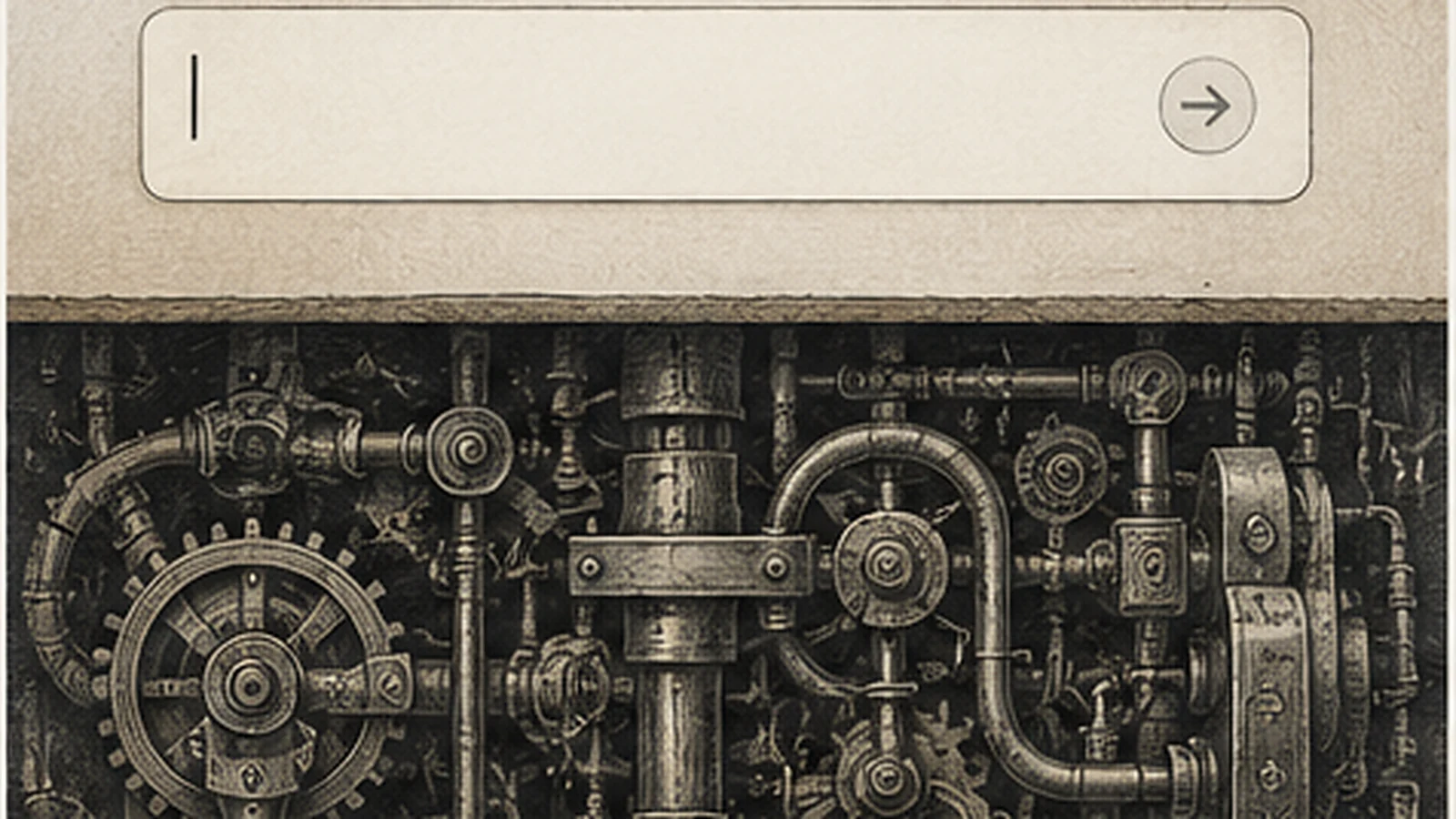
AI frequently offers the opposite experience: a blank box, a blinking cursor, and an invitation to ask for almost anything.
The underlying complexity has not disappeared. Much of it has simply moved out of sight.
That distinction becomes important when we move beyond using AI for an isolated task and begin asking it to participate in meaningful work inside a business.
From a useful output to a useful system
There is a significant difference between producing a good result once and creating a system that can produce useful results consistently.
I learned that while building a tool for a real estate business.
From the Realtor's perspective, the experience was intentionally simple. They entered information about a client considering a move to a particular area, and a few minutes later they received a personalized buyer guide built around that client's needs.
The simplicity was the point.
Behind that experience, however, several different kinds of work had to come together. The information submitted by the Realtor needed to be validated. The location had to be researched according to what mattered to that particular buyer. The research had to become a coherent guide rather than a collection of facts. The finished content needed an additional review for legal and compliance concerns. Appropriate imagery had to be selected, the material had to be assembled into a finished document, and the result had to find its way back to the Realtor.
Without automation, much of that work either requires coordination among people with different skills or simply does not happen because the time and cost are difficult to justify for every client.
AI changed that equation.
It allowed the Realtor to offer something more personalized without asking that Realtor to become a researcher, writer, designer, compliance specialist, or automation engineer. It increased what one professional could provide to a client while leaving the Realtor free to concentrate on the part of the relationship that actually required a Realtor.
That is the kind of leverage I find compelling.
But the simple experience depended on someone understanding the work behind it. Decisions still had to be made about which information mattered, what could be automated safely, where review belonged, what an acceptable result looked like, and what should happen when the process did not follow the expected path.
AI performed a remarkable amount of the work.
It did not eliminate the need to understand the system the work belonged to.
When convincing looks complete
The same tension is becoming visible in software.
Someone with little or no traditional programming experience can now describe an idea and watch an application begin to appear. That is a genuine expansion of who gets to create, and I think it will produce businesses and products that might never have existed when software development required a much higher technical barrier to entry.
But a working demonstration and a dependable production system are still different things.
A quick change can break another part of an application. A shortcut that helped a prototype come together quickly can become a security problem later. Sensitive credentials can end up somewhere they should never have been stored. A system may work beautifully under the conditions its creator imagined and fail the first time a real user behaves differently.
The concern is not that people should stop creating because they lack traditional technical credentials. That would miss much of what makes this moment exciting.
The lesson is simply that ease of creation can make unfinished work feel more complete than it really is.
AI dramatically shortens the distance between an idea and a convincing result. It can also shorten the distance between a mistake and its consequences.
The responsibility is knowing when the difference matters.
The promise is real
None of this makes me less optimistic about artificial intelligence.
Quite the opposite.
Smaller organizations can increasingly afford capabilities that once required far more time, money, or specialized support. Existing teams can take on work that previously sat perpetually at the bottom of the list because nobody had the capacity to do it. People can spend less time moving information between systems, formatting documents, repeating routine research, or performing administrative work that adds little to the reason they were hired in the first place.
That does not have to mean fewer people.
Often the more interesting possibility is more capable people.
A good marketer should be able to spend more time understanding customers and less time resizing assets. An experienced salesperson should be able to spend more time talking to prospects and less time reconstructing information that already exists somewhere in the company. A manager should be able to spend more time exercising judgment and less time assembling the material required to make a decision.
The technology can carry more of the mechanical burden while people apply more of what remains stubbornly human: experience, context, judgment, trust, taste, empathy, and accountability.
Getting there, however, requires more than giving everyone access to a model and assuming the rest will work itself out.
The real estate system was useful precisely because the complexity had been moved away from the person using it. The Realtor did not need to understand the research process, the models involved, the automation platform, the document generation, or the checks happening along the way. They needed to provide what they knew about the client and receive something useful in return.
That is how mature technology tends to evolve.
We do not require people to understand cellular infrastructure before making a phone call or the networks behind a credit-card payment before tapping a card. The experience became simple not because the underlying systems became simple, but because the complexity was engineered somewhere more appropriate.
Artificial intelligence should move in the same direction.
The strongest systems will not be the ones that turn every business owner and employee into an AI specialist. They will be the ones that make capable people more capable while asking less of them that has nothing to do with the work they are actually good at.
WordPress really did make building websites more accessible. It just never made every website good.
AI is opening a much larger door.
The promise is that extraordinary capability can become available to far more people.
The trap is believing that the blinking cursor means all of the hard thinking has already been done.
Kurt Milligan is co-founder and CEO of Spark Evolution. If something here matches a problem you are carrying, start a conversation.